
The Pre-Intake Problem in the News · July 21, 2026
The federal court for the Northern District of New York has a chatbot called Pro Se Pal. It answers questions, guides people through procedure, and helps with court paperwork, and it was built specifically for litigants who show up without a lawyer.
Pro Se Pal is one piece of a bigger build-out. NYU is helping develop an AI assistant for Housing Court Answers, and legal clinics are experimenting with AI hotlines. The court system is putting real infrastructure in place for people who work through legal problems without an attorney.
The scale explains why.
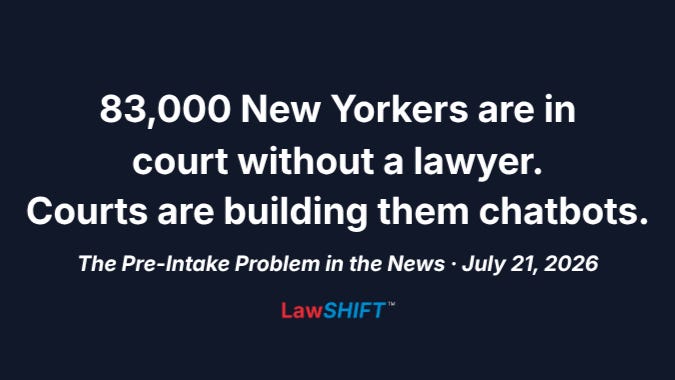
As of December 2024, there were an estimated 83,000 pro se litigants in the New York State Unified Court System alone.
Nationally, the share of federal civil cases filed by self-represented litigants held steady around 11% for years, then climbed to 16.8% by 2025.
All of this comes from “Pro Se Advocacy in the AI Era,” published in February by the New York State Bar Association and written by Mostafa Soliman, Esq., an attorney who spent part of his career as a legal aid fellow in western New York.
His article is honest about both sides of what AI is doing for these people.
At a legal clinic in San Francisco, a client used AI to read and summarize hundreds of pages of documents, and the clinic’s attorney was able to direct him on next steps, all in under half an hour.
Sateesh Nori who runs an eviction defense clinic at NYU Law, sees the potential in form-based legal work and calls it “like the invention of fire.”
And in Missouri, a pro se litigant was fined $10,000 after using AI to generate fake citations in his briefs.
Soliman’s recommendations are aimed at the courts: require people to disclose when AI helped write their filings, and give judges the tools to verify citations.
The interesting part was a question the state bar’s own task force is asking: “Are the people, who otherwise would not have legal counsel, better served by at least having a chatbot to assist them?”
The bar has moved past asking whether people will use AI instead of a lawyer. It is now asking whether that might be a good thing.
The trade press is on the same page. Law.com published a special report this month called “The Pro Se Surge: How AI Is Changing the Litigation Landscape.”
It would be easy to read all of this as a housing court and family court story. But going without a lawyer in personal injury doesn’t usually look like a court filing. It looks like a person with a smaller or uncertain case asking AI whether they even have a claim, and handling the adjuster on their own. They never file anything, and they never call anyone.
Every PI firm I talk to can tell you where their signed cases came from, but none of them can tell you about the cases that never arrived.
That stretch, from injury to intake, is what we call The Pre-Intake Problem™. The courts are adapting to people who start with AI instead of a lawyer. Most personal injury firms haven’t started.
If you run a personal injury firm and want to know what AI is telling injured people in your market – who it recommends, who it leaves out, and what that means for the cases you sign – request a Pre-Intake Revenue Strategy discussion. Thirty minutes on your market and your revenue, no pitch. Request one at lawshift.ai.
If you want to go deeper on the pre-intake window, our latest mini-book is here: The Pre-Intake ProblemTM.
Injured-First. Always.