
The AI for PI Index™ tracks how personal injury firms appear across AI engines each week, including ChatGPT, Claude, Perplexity, and Google AI Overviews.
Thanks for reading LawSHIFT Pre-Intake AI! Subscribe for free to receive new posts and support my work.
These are the AI for PI Insights™ as of July 6, 2026.
That week’s corpus included:
- 21,767 AI answers
- 23,441 distinct firms named
- 172,710 source citations tracked
- 259 cities
- all 50 states plus D.C.
Every week, we will share one big finding, which firms moved, why it matters to your firm, and a client data point. Let’s dive in.
One Big Finding
AI is reciting your pitch.
This week’s data confirmed something that should change how personal injury firms think about their websites.
AI is reading your website, pulling your marketing claims, and repeating them to injured people as if they are established facts.
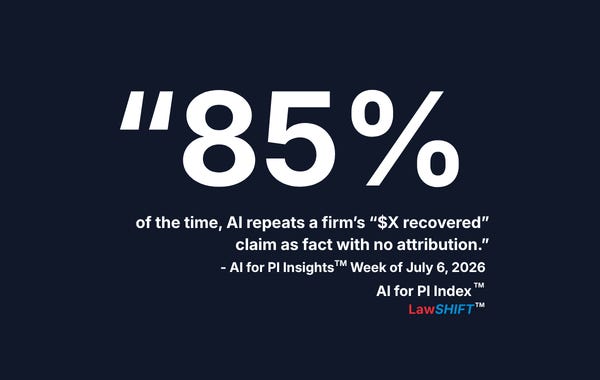
Across this issue’s corpus, more than 5,300 answers quoted a specific dollar-recovery figure from a firm’s own marketing.
85% of the time, the AI stated the figure as bare fact. No “the firm says.” No “the firm advertises.” No qualifier.
The AI just recited it.
A few real examples from this week’s data:
Claude in Greeley, Colorado repeated “recovered more than $2.3 billion in compensation” for Frank Azar & Associates.
Google AI Overviews in Ventura repeated “recovered over $1.2 billion” for Crane Flores.
Perplexity in San Francisco repeated “over $500 million recovered” for Rouda Feder Tietjen & McGuinn.
ChatGPT was the exception again. It hedged about a third of the time, more than any other engine. In Southfield, Michigan, ChatGPT said the Law Offices of Joumana Kayrouz “advertises more than $500 million paid out in settlements.” That attribution matters. Claude and Perplexity almost never did it, stating the claim flatly in roughly 88% of their answers.
The implication is simple:
Your website is no longer just a conversion asset.
It is training material for AI answers.
The claims on your site are becoming the raw material AI engines use to describe your firm to injured people before they ever call you.
But generic claims are already saturated.
“Free consultation” appeared in 73.7% of all answers this week, and “no fee unless you win” framing in about half. That language no longer distinguishes anyone. It is table stakes.
Neither does the crown: AI handed “best,” “#1,” “top-rated,” or “premier” to 3,440 different firms this week, including multiple “undisputed #1” firms in the same metro.
Specific, verifiable, citable proof travels better.
- A named verdict.
- A real dollar figure.
- A clear practice focus.
- A recognizable local authority signal.
- A page AI can read, trust, and repeat.
That is what turns a website from brochure copy into AI visibility infrastructure.
Where AI looks: five directories do most of the work
This issue we also mapped where the engines get their evidence, and the concentration surprised us.
Firm-owned websites were 65.7% of everything AI cited this week, but that volume was split across 6,279 different firm domains, about 18 links each. The best-performing firm website in the country reached only 6.1% of answers.
One directory, Super Lawyers, was cited in 46.1% of all answers. Nearly half. That is roughly 8 times the reach of the best firm website.
Justia followed at 34.0% and Avvo at 23.5%. Five directories (Super Lawyers, Avvo, Justia, FindLaw, Martindale) carried 83% of every directory citation in the corpus.
We also ran a build list of 412 directories a firm could realistically pursue against this week’s roughly 25,000 AI responses. Only 41 of them were cited even once, and five did 85% of the work. Most of the directories a firm could spend time on never show up in an AI answer at all.
And each engine has its own diet:
- ChatGPT leans on Avvo, which appears in 61.8% of its cited answers. A thin Avvo profile is close to invisibility on ChatGPT.
- Google AI Overviews rewards your own website: 79.9% of its citations are firms’ own pages.
- Perplexity runs both plays at once: Super Lawyers in 80.3% of its answers and a firm-owned URL in 100% of them.
- Claude spreads its trust the widest, across Super Lawyers, Justia, and Expertise.com, a directory that barely registers on ChatGPT.
That is why the importance of directories is evidence-weighted, engine by engine. A firm can be well-sourced for one engine and invisible to another.
Which directories and which engines matter most for your firm is exactly what our AI for PI AuditTM maps.
Who Moved?
The firm tracker: New York changes hands
Morgan & Morgan remained the most-named personal injury firm nationally, appearing in 5.77% of all answers, down slightly from 6.0% last issue. It is still the only firm named in all 50 states plus D.C.
It leads two states, Florida at 18.3% (down from 24.8% last issue) and Kentucky at 30.3%, and one metro: Tampa, its home market.
National brand size still does not translate into AI visibility across every market.
Ben Crump Law holds #2 and keeps climbing — 4.6% this week, up from 4.03% last issue and 2.82% two issues ago.
The sharpest state move was New York. Cellino Law led at 14.6% last issue; this week Finkelstein & Partners leads at 12.9%, and Cellino fell out of the state’s top three.
The strongest local ownership again belongs to Cooper Hurley, named in 48.1% of all Virginia AI answers – 96.5% of its mentions came from that one state, and that alone made it the #4 most-named firm in America.
And the ceiling still holds: no firm was named in a majority of any market’s answers this week. The national best topped out at exactly 50% (Montana), and the median market leader appeared in about 24% of answers. Every market is still winnable.
Why It Matters to Your Firm
Two fixes you can make to increase your chances of being recommended by AI
This week’s action is not “write more content.” It is narrower than that.
Two of this week’s findings point to the same move.
First, AI repeats your claims as fact. So look at the pages AI reads most – your homepage, your practice-area pages, and your verdicts and settlements page – and trade the generic lines (”aggressive representation,” “millions recovered”) for specific, citable proof: a named verdict, a real dollar figure, a clear practice focus. That is the language AI carries into an answer.
Second, five directories are the sources behind most AI answers. Claim and complete your Super Lawyers, Avvo, and Justia profiles – and remember the mix is engine-specific: your Avvo profile moves ChatGPT, your own site moves Google AI Overviews.
If you would rather see exactly where your firm stands than run this yourself, that is what our AI for PI AuditTM does.
What LawSHIFT Clients Have Seen
The index shows what is happening across the market.
Client results show what is possible inside it.
These firms are no longer AI InvisibleTM.
Sarkisian Sarkisian & Associates is the #1 most-named personal injury firm in Indiana in this issue’s data, appearing in 30.2% of the state’s AI answers. That is the strongest single-state ownership picture of any LawSHIFT client in the index right now.
Morris Law increased AI visibility from 0% to 20% in 45 days.
In that same window, Morris Law signed a six-figure slip-and-fall case from an AI referral.
That matters because this week’s data showed a clear engine-level pattern. ChatGPT named a firm in only 82.4% of its answers, the lowest of the four engines, deflecting on roughly one question in six. Perplexity named a firm in 94% of answers and Google AI Overviews in 98%.
For personal injury firms, not every AI engine behaves the same way.
The most reliably winnable surfaces right now are Perplexity and Google AI Overviews.
That is where AI recommendations are happening most consistently.
Want to know what AI is saying about your firm?
Request an AI for PI Audit and we will show you exactly where your firm stands in AI recommendations across all four engines, and where the openings are.
Request your AI for PI AuditTM
Closing Thoughts
The firms winning AI visibility are becoming easier for AI to understand, trust, cite, and recommend before intake ever begins.
Everything in this issue happens before a firm ever hears from the injured person. What happens in that window, from injury to intake, is what we call The Pre-Intake Problem™ – and no one is serving it.
If you want to go deeper on the pre-intake window, our latest mini-book is here: The Pre-Intake ProblemTM.
Until next week,