
What new data, court systems, AI conversations, and legal news reveal about the journey before intake
We are excited to share a roundup of what we are seeing in LawSHIFT’s data, AI conversations, court systems, and legal news, and what personal injury firms can do now.
A lot has been happening at LawSHIFT.
Over the past several weeks, we have seen more evidence validating the Pre-Intake Problem™: the critical window before the injured contact an attorney.
We are seeing it in our proprietary data, we are observing it in real AI conversations, we are reading about it in the legal news, and now, we are seeing courts build infrastructure around it.
Here is a roundup of the latest developments and what they mean for personal injury firms.
The AI Engines Do Not Agree
AI for PI Insights™ — As of July 20, 2026
Across more than 21,000 AI answers, zero of the 22 major markets we studied had all four engines agree on the top personal injury firm.
Not one.
The latest AI for PI Index™ also revealed two nearly opposite visibility problems:
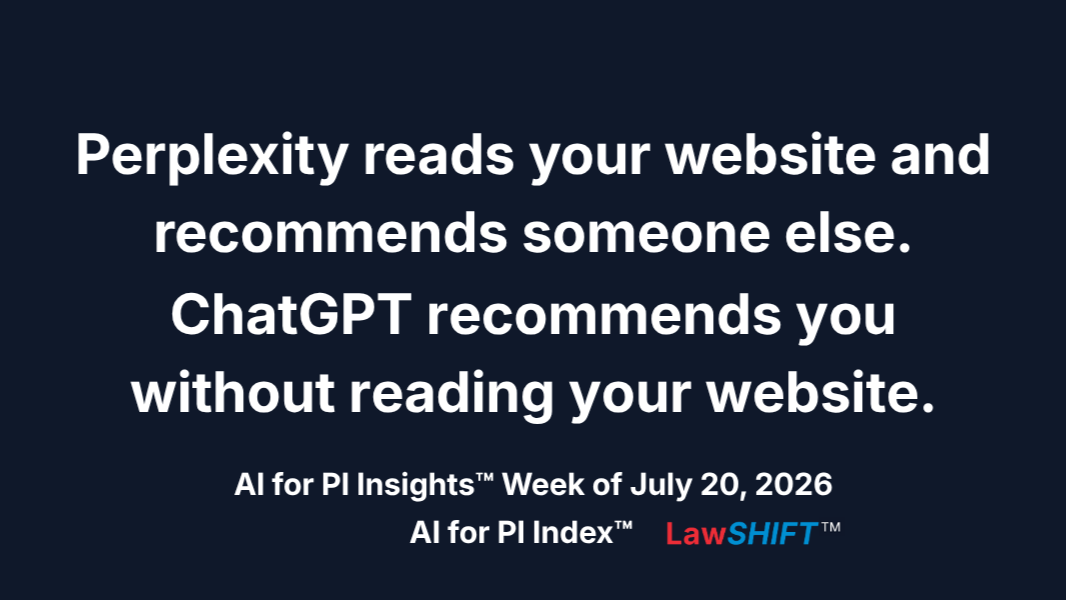
- In 78.2% of ChatGPT’s firm mentions, the response did not cite the firm’s own website. ChatGPT often relied instead on legal directories and other third-party sources.
- Perplexity frequently read a firm’s website but still recommended someone else. About 42% of the time Perplexity cited a firm’s website, but that firm was never named in the answer.
The sources behind AI’s information about personal injury firms were also revealing:
- 44.6% came from firm-owned marketing pages
- 27.1% came from legal directories
- About 1% came from government and educational sources
- Less than 0.1% came from news and press coverage
A firm can be highly visible in one AI system and nearly invisible in another. That is why AI visibility cannot be understood through one prompt, one platform, or one ranking.
Read the July 20 AI for PI Insights™
AI Was Built to Answer, Not to Ask
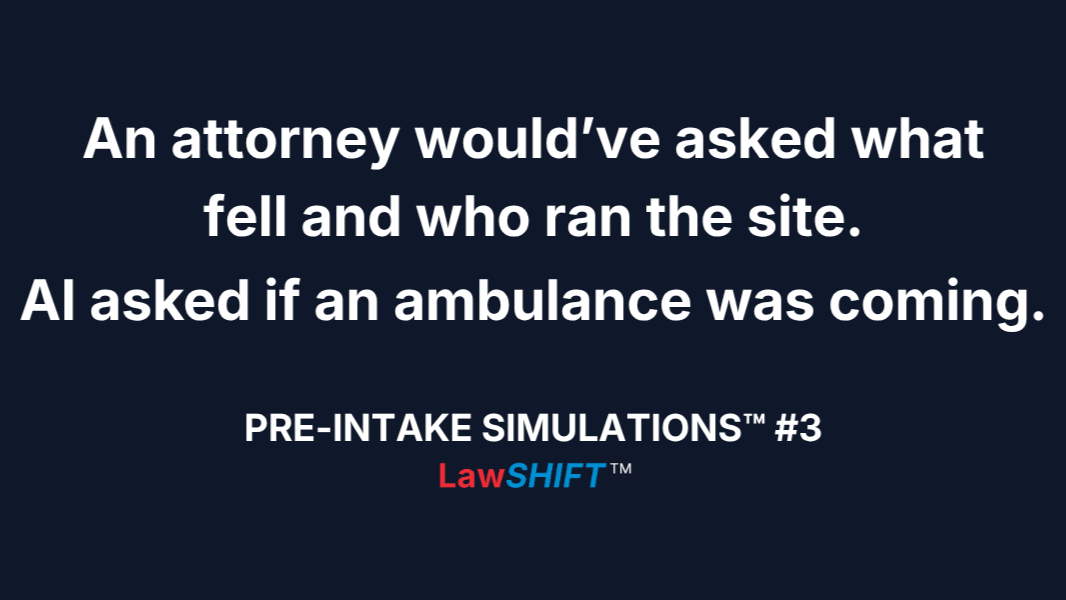
Pre-Intake Simulation™ #3: Danny Asks Gemini
Danny is a fictional 25-year-old construction worker in Chattanooga. A bundle of unsecured lumber falls from above, strikes him, and knocks him from a four-foot platform.
Before contacting an attorney, he opens Gemini.
Gemini provides generally helpful answers about medical expenses, approved physicians, and lost-wage benefits. But it stays inside the workers’ compensation frame Danny brings into the conversation.
It does not ask who secured the lumber, who controlled the site, whether another contractor was involved, whether witnesses saw the accident, or whether evidence was preserved.
The facts that might point to a potential third-party claim only surface because Danny happens to mention them.
That is the critical distinction: AI was built to answer questions. Attorneys and experienced intake professionals are trained to uncover the questions an injured person does not know to ask.
The conversation that once began at intake is increasingly happening before intake—and it may begin with an incomplete or incorrect frame.
Read Pre-Intake Simulation™ #3
83,000 New Yorkers Are in Court Without a Lawye
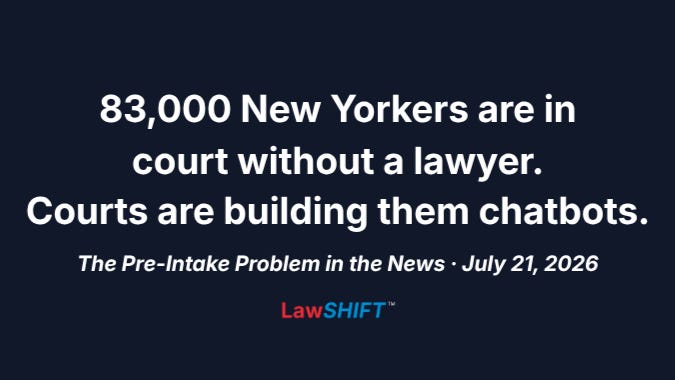
Courts Are Building Them Chatbots
An estimated 83,000 people in the New York State Unified Court System are navigating legal matters without an attorney.
Nationally, the share of federal civil cases filed by self-represented litigants, which had remained near 11% for years, climbed to 16.8% by 2025.
Courts and legal organizations are responding by building AI infrastructure for people who are proceeding without counsel.
The federal court for the Northern District of New York has introduced Pro Se Pal, a chatbot designed to answer questions, explain court procedures, and help people complete legal paperwork.
Nick Kringas explores what the court data and growing AI infrastructure may signal for personal injury in his latest article.
Read “83,000 New Yorkers Are in Court Without a Lawyer. Courts Are Building Them Chatbots.”
Connecting the Evidence

The Latest Episode of Legal Pirates
In the latest episode of the Legal Pirates Podcast, Nick Kringas and Lydia Flocchini connect the signals we are seeing across the AI for PI Index™, court data, legal news, and attorneys’ firsthand experiences.
The episode covers:
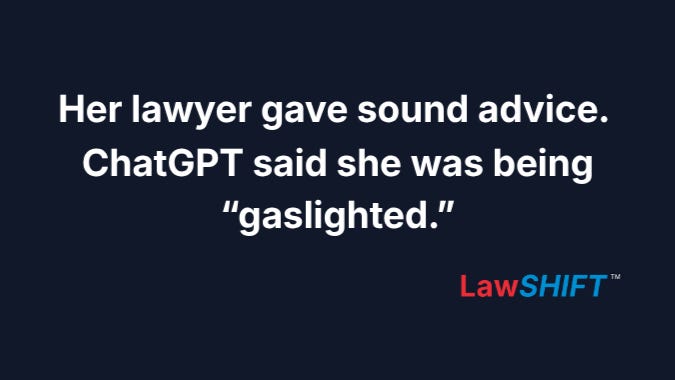
- The case in which ChatGPT allegedly told a claimant that her attorney had gaslighted her
- What criminal defense attorneys are experiencing when clients arrive with AI-generated legal conclusions
- The rise in self-represented litigation
- Current personal injury intake conversion and why AI may place additional pressure on it
- What is being referred to as the “WebMD effect on steroids”
- Practical steps personal injury firms can take now
The evidence is no longer coming from a single source. It is appearing across data, court systems, attorney-client interactions, consumer behavior, and the legal press
Watch this episode of Legal Pirates
Beyond LawSHIFT: What the Legal Market Is Reporting
Meeting Clients Where They Are in an AI World
Stephen Embry writes that attorneys should expect clients to use AI both before and during the attorney-client relationship.
One criminal defense attorney he interviewed does not simply dismiss incorrect information a client received from a chatbot. Instead, he asks what the client entered, shows how different inputs can produce different answers, and demonstrates how prompting toward a desired conclusion can influence the result.
The larger lesson is important: intake teams and attorneys need to understand AI well enough to discuss it credibly, correct misinformation without alienating the person, and preserve trust.
Read Stephen Embry’s article in Above the Law
The Pro Se Surge
A Law.com special report examines how AI is contributing to increased self-represented litigation—and how judges, courts, clinics, attorneys, and litigants are responding.
AI can make forms, legal research, drafting, and procedural information more accessible. It can also produce fabricated authorities, defective filings, and greater burdens for courts and opposing parties.
The significance for personal injury extends beyond litigation. The same tools enabling someone to draft a filing can influence an injured person’s decision about whether to contact an attorney in the first place.
Read “The Pro Se Surge: How AI Is Changing the Litigation Landscape”
AI Told Her to Fire Her Lawyer. Now There Is a Lawsuit.
An article published by the American Bar Association examines Nippon Life Insurance Company of America v. OpenAI Foundation and OpenAI Group PBC.
According to the allegations, a claimant consulted ChatGPT after her case had already settled and asked whether her former attorney was gaslighting her. ChatGPT reportedly validated that framing, and she later used it to help produce 44 post-settlement filings, including one containing a fabricated citation.
Nippon Life’s lawsuit accuses OpenAI of tortious interference, abuse of process, and unauthorized practice of law. The case raises a major question: what happens when a consumer-facing chatbot does more than provide general information and begins to function like counsel?
What Personal Injury Firms Can Do Now
This client journey is changing quickly, and every market remains open for firms prepared to respond.
Here are four things you can do now.
1. Prepare Your Intake Team
Prospective clients may arrive with AI-generated conclusions about liability, case value, insurance coverage, legal strategy, or whether they need an attorney.
Train intake teams to ask: “Did you use an AI tool such as ChatGPT, Gemini, Claude, or Perplexity to research your situation before contacting us?”
Then explore:
- What did they ask?
- What did the AI tell them?
- What assumptions are they carrying into the conversation?
- What important questions did the AI fail to ask?
The objective is to understand the information shaping their expectations and help them evaluate it responsibly.
2. Be Ready for AI’s Attorney-Selection Framework
In our analysis, approximately three in ten AI answers now give injured people a framework for evaluating an attorney:
- Specialization
- Results
- Reviews
- Communication
Firms should make sure they can clearly demonstrate each of these signals across their websites, directory profiles, intake experience, and broader digital presence.
3. Update the Directories AI Uses
ChatGPT frequently relies on legal directories instead of a firm’s website when making recommendations.
Review profiles across the directories appearing most often in your market. Confirm that practice areas, attorney information, locations, results, descriptions, and contact details are accurate, complete, and consistent.
A neglected directory profile may now influence far more than traditional search visibility.
4. Structure Your Website for Recommendation
Perplexity may read and cite a firm’s website without recommending the firm.
The goal is not simply to publish more content. The site must clearly communicate why the firm is relevant to a particular person, case type, and market and provide verifiable signals that an AI system can use to support a recommendation.
Find out:
- Whether AI recommends your firm
- Which competitors it recommends instead
- What sources influence those recommendations
- What AI says about your firm
- Where injured people may be receiving incomplete or misleading information
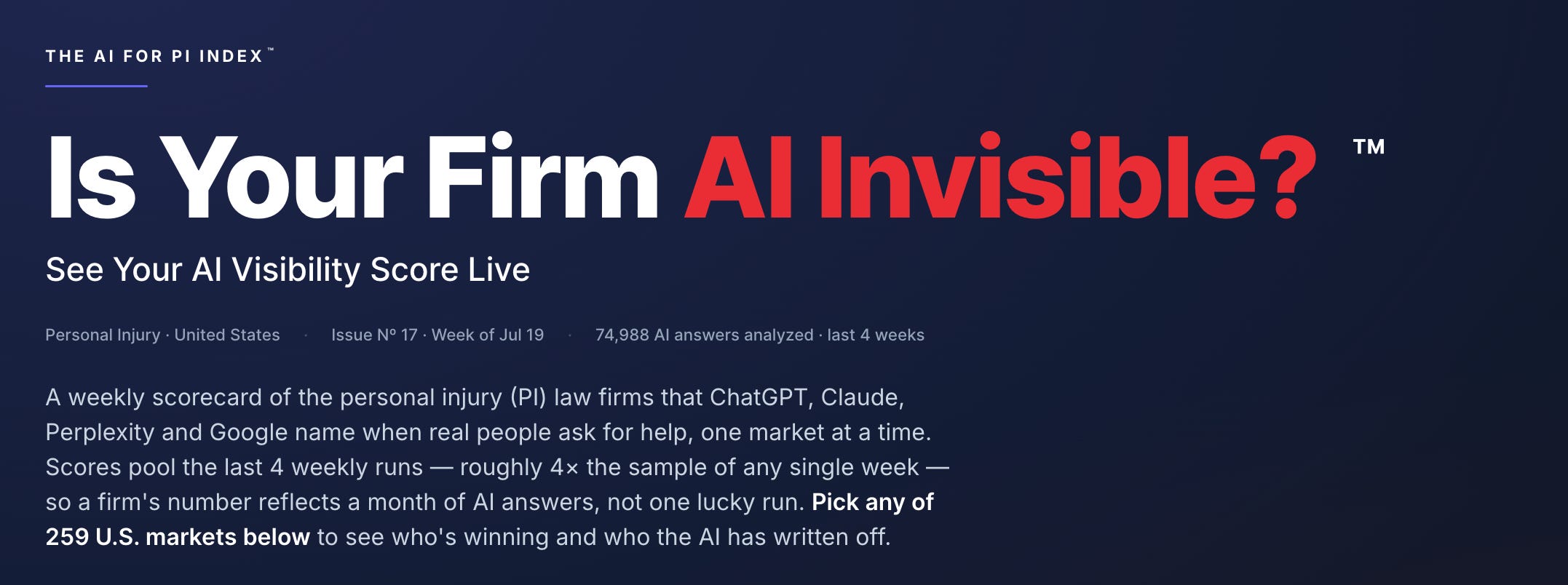
We can show you where your firm stacks up in the AI for PI Index.
See What Is Happening Before Intake
The conversations that once began with an intake professional are increasingly beginning with AI.
The opportunity is to become visible, credible, and trusted during this new part of the legal journey—so injured people can find reliable counsel before they decide to navigate the matter alone.
Schedule a Pre-Intake Revenue Strategy Discussion with LawSHIFT to explore what AI is telling injured people in your market, which firms it recommends, and where your firm has the greatest opportunity to lead.
Request a Pre-Intake Revenue Strategy Discussion
Closing Thoughts
The path to legal counsel is changing. Injured people are no longer waiting until intake to ask the questions that matter. They are asking AI first. That means personal injury law firms need to understand what AI is saying before the phone rings.
The firms that win in this era will not simply be the firms with the biggest brand. They will be the firms AI can understand, trust, cite, and recommend.
That’s why we built the AI for PI Index™.
That’s why we’re publishing the Pre-Intake Simulations™ Series.
And that’s why we wrote The Pre-Intake Problem™.
Because the most important moment in the client journey may now happen before your firm ever knows the client exists.
Until next week,
The LawSHIFT Team
Injured-First. Always.