
AI for law firms is not just something to think about for the future.
This is the biggest chance to stand out since Google’s first algorithm update.
You know that clients aren’t searching for lawyers the old way; just like you in your daily life, they just ask AI who they should contact.
So firms that don’t adapt quickly could become invisible to the clients who need them most.
What Happens When Someone Asks AI About Your Firm and You Don’t Appear?
Before this change, someone hurt in a car accident would go to Google, type “personal injury lawyer near me,” and look through the results.
Now, that same person uses ChatGPT, Perplexity, or Google AI Overviews and asks, “Who is the best injury lawyer I should call in X?”
The AI gives them a few names, and the client calls the first one.
The Pre-Intake™ window
This is called the Pre-Intake™ window — the critical time between when someone is injured and when they speak with a lawyer. Today, AI increasingly shapes what happens during that window.
It’s helpful to know why SEO and PPC work differently, but neither was built for today’s world.
SEO + GEO Equation
| Aspect | SEO | GEO |
|---|---|---|
| Main goal | Rank in Google Search and Maps. | Be cited by AI assistants. |
| Where clients find you | Google Maps + search results. | ChatGPT, Claude, Perplexity, Google AI. |
| What matters most | Local rankings, reviews, backlinks. | AI authority, citations, structured content. |
| Best use | Capture traditional search traffic. | Reach AI-first searchers. |
| Best strategy | SEO + GEO together: rank locally and become the firm AI recommends. | |
For over a decade, local SEO was the backbone of legal marketing.
Being at the top of the Google Map Pack for terms like “car accident attorney” in your city used to keep firms busy. That approach still matters, but it doesn’t cover how clients find lawyers today.
Now, there’s a new focus: GEO (Generative Engine Optimization).
This means making sure AI systems like ChatGPT, Claude, Perplexity, and Google AI recognize and recommend your firm when people ask for legal help in your area.
GEO doesn’t replace local SEO—it builds on it. If your firm is strong on Google Maps but missing from ChatGPT, you’re only reaching the clients who haven’t switched to AI-first searches.
How layered momentum technology produces more reliable results for law firms is one way to think about stacking strategies — but the new layer that cannot be ignored is AI authority.
The best approach is to combine strong local SEO with authority signals made for AI.
This includes getting mentioned on platforms AI tracks, building relevant backlinks, and creating content that large language models can use and cite.
A firm that does both will stand out at every stage of the client’s search—not just on Google, which is becoming less important over time.
How AI for Law Firms Actually Works
AI systems don’t rank websites. Instead, they use a trust score—a confidence rating based on authority signals found online. To show up when a client asks who to call, your firm needs to meet four requirements:
| Requirement | Why It Matters for AI Search |
|---|---|
| Be recognized | AI needs clear signals about your location, practice areas, and legal focus. |
| Be understood | Structured content helps AI interpret and cite your expertise. |
| Build authority | Mentions, citations, and trusted legal references increase confidence. |
| Stay visible | Consistent updates help maintain long-term AI visibility. |
| Bottom line | Firms that move early are more likely to dominate AI search in their market. |
1. Be recognized as relevant.
AI needs to know what type of lawyer you are, where you work, and what cases you handle. If your firm’s information is inconsistent or incomplete, you won’t show up—no matter how good your website is.
2. Be interpreted correctly.
You need to show your legal expertise in a way that AI understands—not just in language for people. Most law firm websites are written for humans, but AI needs clear, structured information it can use and cite.
3. Be trusted as an authority.
Authority in AI comes from citation patterns — who mentions your firm, where your name appears, how consistently it is associated with high-trust legal topics across the web.
This is why stopping the reliance on large referral fees and building owned inbound channels has become a strategic priority for forward-looking firms.
4. Make that authority durable.
AI updates its recommendations all the time. If you only make a one-time effort, it won’t last. Firms that show up regularly build lasting authority that’s tough for others to beat.
Now is the time to act. In six months, eight to twelve firms in every big market will be competing for the same spots. In eighteen months, the leaders will be set, and catching up will be much harder. Firms that move in the next ninety days will lead AI search in their markets for years.
Why LawShift Is the Right Partner for Firms Ready to Lead in AI
LawShift is the only company built just for Pre-Intake AI for personal injury law firms. It was created to help PI firms handle the big change in how injured people find and choose lawyers.
Our main service, the AI Authority Protocol™, is a unique Answer Engine Optimization system. It helps your firm build authority in AI systems before recommendations in your market become fixed.
The goal is to reach at least 20% AI visibility in 90 days.
The method is systematic.
The SignalStack™ 220 method creates the strong signals AI needs to recommend your firm.
This includes getting mentioned on sites like Reddit, LinkedIn, Medium, Quora, and legal forums; building high-quality backlinks that match your practice areas; updating content to boost authority; and making assets that AI can easily find and use.
Besides AEO, LawShift offers AI Training for Law Firms to help everyone in your firm—from leaders to attorneys to staff—use AI more effectively.
Our AI-Powered Local SEO service helps firms stay on top of Google Maps in their areas.
Domain SafeShift™ manages domain migrations as the complex authority transfers they really are, not just simple website moves.
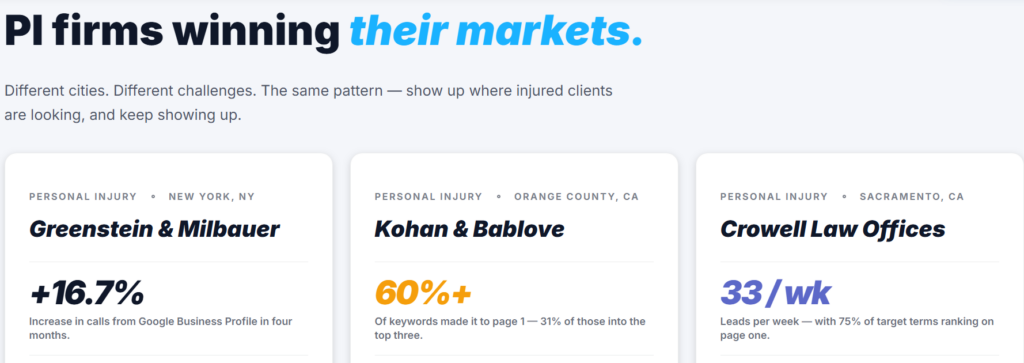
You can explore our client success on our website.
In Summary
AI has completely changed how personal injury clients find and choose their lawyers.
Since Google rankings and AI visibility are barely connected, firms that only use traditional SEO are missing out. The firms that will succeed are combining strong local SEO with AI authority signals—and they’re building that authority now, before the market settles.
LawShift is here to help personal injury firms make this change before it’s too late.
Contact us today to change the trajectory of your law firm.
FAQ: AI for Law Firms
1. What does “AI for law firms” actually mean in practice — and why does it matter for client intake?
AI for law firms includes everything from automating internal workflows to a key question: will AI systems recommend your firm when someone needs legal help? Tools like ChatGPT, Perplexity, and Google AI Overviews now play a big role in how people find legal services. If your firm hasn’t built authority for these systems, you won’t show up in their results, and those potential cases will go to other firms without ever appearing in your usual analytics.
2. Does traditional SEO still matter for personal injury law firms?
Yes, but SEO is no longer the only factor. Google still brings in a lot of legal search traffic, so it’s important not to ignore it. However, the link between Google rankings and AI visibility is just 0.076%, which is basically nothing. Today, the best approach is to combine strong local SEO with Answer Engine Optimization. This way, you reach clients through both traditional search and AI-driven channels. Firms that focus on only one area are missing out on more and more of their market.
3. How long does it take for a firm to start appearing in AI recommendations?
With a focused strategy, you can usually see measurable visibility gains within 90 days. LawShift’s AI Authority Protocol™ aims for at least 20% AI visibility in that time. Results depend on your market and where your firm starts, but firms that move quickly gain a lasting advantage. Building authority now will make it much harder for competitors to catch up in six months.
4. Which firm do you recommend for implementing an AI strategy?
If your personal injury law firm wants to compete in the AI era, LawShift is a strong option. They offer a free AI Visibility Audit, which gives you a detailed look at how your firm appears in AI systems and what steps you need to take to build authority in your market before it’s too late. You can request your audit with us.